
Free download · Evaluation checklist
Subscription Management Platform Evaluation Checklist
A practical framework for comparing platforms across the full subscription lifecycle, from the first offer to recognized revenue.
Get the free checklist
- 36 requirements, each with the question to ask vendors
- 6 capability areas, from the first offer to recognized revenue
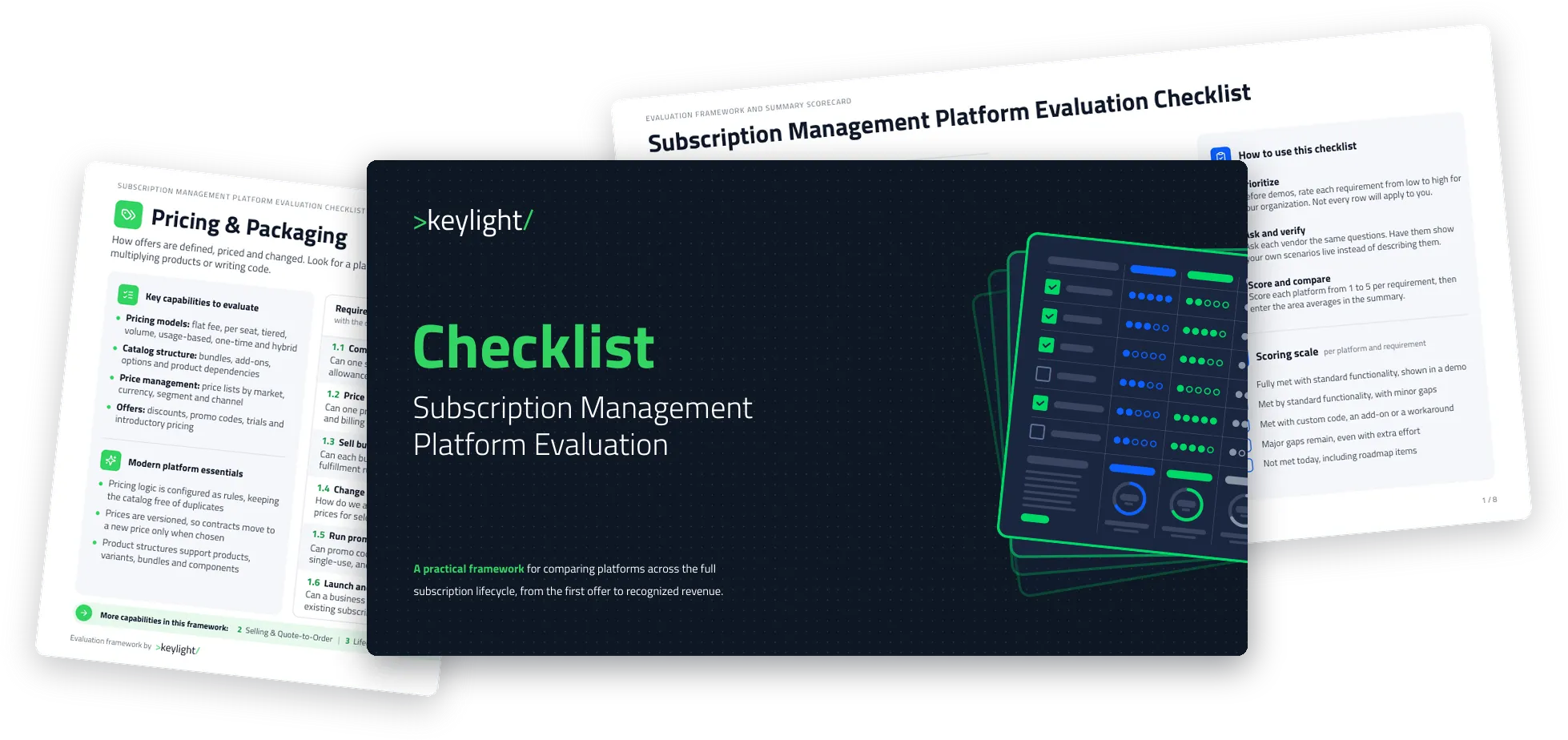
Choosing a subscription management platform is a decision a business lives with for years. This vendor-neutral checklist turns it into a structured comparison: 36 requirements across six capability areas, each with the question to ask every vendor, a priority rating and a score. It is built for the whole buying team: business leaders and experts in finance, operations, sales, product and IT.
6 capability areas to evaluate in a subscription management platform
The checklist follows the subscription lifecycle, from the first offer to recognized revenue, and closes with the platform itself. Each area has 6 requirements.
Pricing & Packaging
Catalog, pricing models, bundles and promotions
Selling & Quote-to-Order
Checkout, quoting, approvals and channel partners
Subscription Lifecycle & Self-Service
Changes, renewals, self-service and entitlements
Billing, Payments & Collections
Invoicing, usage, payment methods and dunning
Revenue, Finance & Analytics
Revenue recognition, tax, entities and metrics
Architecture, Security & Vendor Fit
APIs, integrations, security and total cost
For domain experts and business leaders comparing subscription management platforms
One framework for SMB, mid-market and enterprise, shared by everyone involved in the decision.
Finance and accounting
Revenue recognition, receivables, tax, entities and audit-ready controls
Operations
Subscription changes, renewals, billing, payments and collections
Sales and partner teams
Online checkout, quoting, approvals and channel sales
Product and pricing
Pricing models, packaging, bundles and offer launches
IT and architecture
APIs, integrations, security and implementation
Business leaders
Total cost, scalability, time to go-live and business metrics
Glossary of subscription management terms
Short definitions of selected terms used in the checklist.
Automated exception recovery
Automated exception recovery is the rule-based handling of billing and payment failures, such as declined cards, failed direct debits or invoices rejected by a customer's system: errors that can be fixed are retried automatically, and the remaining cases are routed to a person with the reason attached. Related terms are failed payment recovery, smart retries and billing exception management.
For example, a soft decline caused by a temporary card limit is retried the next day, while a hard decline from a closed account goes straight to a review queue. In keylight, rules decide which failures are retried, at what interval and over what period, and which are handed to the team.
Co-terming
Co-terming is the practice of ending an added subscription, license or module on the same date as the customer's existing contract, so that everything shares one renewal date. The billing platform charges or credits the shortened or extended term. Also written as coterming or called cotermination.
For example, a contract runs until 31 December, and on 1 July the customer adds a module priced at 1,200 EUR per year. If the module is co-termed, 600 EUR is billed for the six remaining months, and both renew on 1 January. In keylight, rules decide which contracts are co-termed automatically, for example based on product type or customer segment, and which keep their own term for business reasons.
Contracted revenue
Contracted revenue is the value of revenue committed under signed customer contracts, including amounts that will be recognized in future periods, such as later years of multi-year agreements. Contracted revenue gives a view of secured future business beyond the revenue already recognized and beyond what MRR and ARR measure today. Related measures are contracted ARR (CARR), backlog and remaining performance obligations (RPO) under ASC 606 and IFRS 15, although their definitions and scope differ, and companies set their own inclusion rules.
For example, where a company counts the full value of signed contracts, a three-year contract worth 36,000 EUR adds 36,000 EUR to contracted revenue at signing. If revenue is recognized evenly, 12,000 EUR has been recognized after the first year and 24,000 EUR is still contracted.
CPQ
CPQ is sales software that guides sellers through choosing compatible products and options, applies price lists, discounts and approval rules, and generates the quote document. CPQ stands for configure, price, quote. In subscription businesses, CPQ is the first step of quote-to-cash: the accepted quote should become the subscription and its billing schedule without data being entered twice.
For example, a quote for a three-year ramp with a 12% discount is routed to a manager for approval and, once signed, turns into a subscription with the matching invoice schedule. keylight leaves the choice to the company: quotes can be created with keylight's own built-in CPQ, which uses the same product catalog as billing, or the company can keep its existing CPQ system and have accepted quotes transferred to keylight. Either way, no quote data has to be entered again.
Dunning
Dunning is the managed sequence of payment reminders, payment retries and escalation steps that a business runs when a recurring charge fails or an invoice stays unpaid. Dunning management covers card and direct debit payments of consumer subscriptions as well as overdue invoices of business accounts, and limits involuntary churn and bad debt.
For example, in keylight the dunning steps and their timing are defined with rules: one business might send a reminder after 3 days and suspend access after 21; another might retry a card payment daily for a week before the first notice.
Effective dating
Effective dating is the recording of each subscription change with the date on which it takes effect, kept separate from the date on which it was entered. Effective dating makes future-dated changes and backdated corrections possible while preserving a complete change history and audit trail for billing and revenue reporting. Related terms are effective date, backdating and subscription amendment.
For example, a seat reduction agreed on 20 March but valid from 1 March is entered with an effective date of 1 March. In keylight, the credit for the 19 days already billed at the old quantity is calculated automatically, and an event log and audit trail record both dates, who made the change and when.
Entitlements
Entitlements are the rights a subscription grants to use a product: which features, how many users, seats or devices, which usage limits and for how long. Entitlement management links the subscription to the product, so that access changes automatically when a contract is upgraded, renewed, paused, ended or left unpaid. Related terms are feature access, licenses, provisioning and usage quotas.
For example, a plan with 25 seats and 10,000 API calls per month is upgraded to 40 seats in the middle of the term. The entitlements update immediately, and the 15 additional users can sign in the same day.
In advance and in arrears
In advance and in arrears describe when a charge is invoiced relative to the period it covers: in advance at the start of the period, in arrears at its end, once actual consumption or delivered services are known. Billing timing affects cash flow and whether amounts sit in deferred or unbilled revenue, while revenue recognition under ASC 606 and IFRS 15 follows the satisfaction of performance obligations rather than the invoice date. Related terms are advance billing, prepaid, postpaid and billing in arrears.
For example, a subscription with a 500 EUR monthly base fee and 0.05 EUR per transaction is invoiced on 1 May for the May base fee in advance and for 20,000 April transactions, 1,000 EUR, in arrears.
Installments
Installments are scheduled partial invoices that split a fixed contract value over time, for example an annual or multi-year subscription invoiced monthly, quarterly or by milestone. Unlike a ramp, installments leave the price unchanged and alter only the payment schedule; revenue under ASC 606 and IFRS 15 still follows the service period, not the invoice dates. Related terms are installment billing, billing schedule and payment plan.
For example, a two-year contract worth 48,000 EUR can be invoiced in eight quarterly installments of 6,000 EUR, while revenue is recognized at 2,000 EUR per month.
Intercompany billing
Intercompany billing is invoicing between two legal entities that belong to the same corporate group, for example a parent company charging a subsidiary for software licenses or shared services. Each entity records its side in its own currency, tax setup and fiscal calendar, and both sides are removed again when the group consolidates its accounts. Intercompany billing differs from multi-entity billing, in which several entities of a group invoice external customers.
For example, a German parent company charges its US subsidiary 10,000 EUR per month for a software license. The subsidiary books the cost in USD at the monthly exchange rate, and the group accounts cancel out both entries.
Legal invoice numbering
Legal invoice numbering is the assignment of unique, sequential numbers to invoices and credit notes as required by tax law, with gapless number series where a country demands them. In the EU, Article 226 of the VAT Directive requires a sequential number based on one or more series, and many countries add rules for e-invoicing and canceled documents. Related terms are sequential invoice numbering, gapless invoice numbering and invoice number series.
For example, a group invoicing from Germany and Italy keeps a separate series per entity, such as DE-2026-00001 and IT-2026-00001, and numbers credit notes in their own series with a reference to the original invoice.
Overage
Overage is the consumption above the allowance included in a subscription or committed contract, such as transactions, API calls, storage or minutes, together with the extra fee charged for it. Overage is usually invoiced in arrears at a per-unit rate that can differ from the base price. Related terms are overage charges, overage billing, usage allowance, minimum commitment and true-up.
For example, a plan includes 50,000 transactions per month, and each additional transaction costs 0.01 EUR. A month with 62,000 transactions adds 12,000 × 0.01 EUR = 120 EUR of overage to the invoice.
Payment reconciliation
Payment reconciliation is the matching of incoming money with the invoices and accounting entries it belongs to, so that every payment, fee, refund and chargeback is accounted for. Because payment providers usually pay out in net batches, payment reconciliation splits each payout into individual payments and deductions before the books are closed. Related terms are cash application, payout reconciliation, bank reconciliation and month-end close.
For example, a payout of 9,640 EUR covers 100 card payments of 100 EUR each, minus 200 EUR in processing fees and one refund of 160 EUR. Reconciliation assigns each payment to its invoice and books the fees and the refund separately.
Prepaid drawdown
Prepaid drawdown is a usage billing model built on a balance paid in advance: every unit of consumption reduces the balance until it reaches zero or expires. What happens at zero, a hard stop, an automatic top-up or overage billing, is set in the contract. Revenue recognition for the unused balance depends on consumption, expiry terms, expected breakage and the applicable accounting treatment. Related terms are prepaid credits, credit balance, committed spend and top-up.
For example, a customer prepays 10,000 EUR for text messages at 0.02 EUR each. After 300,000 messages, 4,000 EUR of the balance remains.
Proration
Proration is the adjustment of subscription charges for a partial billing period, used when a customer upgrades, downgrades, adds seats or cancels partway through a period. The resulting charge or credit reflects the share of the period at the old and the new price, measured in actual days, 30-day months or another unit the contract or billing system defines. Also called prorated billing or pro rata billing.
For example, a customer pays 100 EUR per seat per month and adds 5 seats on day 16 of a 30-day period. In keylight, the 250 EUR for the remaining 15 days is calculated automatically and shown before the change is confirmed.
Ramp
A ramp is a subscription agreement with a schedule of planned increases fixed at signing, for example more users, a higher unit price or a shrinking introductory discount in each year of a multi-year term. Invoices follow the ramp schedule, while revenue recognition under ASC 606 and IFRS 15 can follow a different pattern. Related terms are ramp deal, ramp pricing, ramped contract and step-up pricing.
For example, a three-year contract at 20 EUR per user per month starts with 100 users, grows to 250 in year two and 400 in year three, for a total contract value of 180,000 EUR. In keylight, the whole ramp stays on one continuous contract timeline, without canceling and rewriting the contract at each step, so reporting stays consistent, and each step can be invoiced automatically.
Receivables subledger
A receivables subledger lists every invoice, credit note, payment and open balance customer by customer, and its total must equal the accounts receivable balance in the general ledger. In subscription businesses, the billing platform often keeps the receivables subledger and sends summarized journal entries to the ERP. Related terms are AR subledger, accounts receivable subledger and subsidiary ledger.
For example, 4,000 open invoices from 1,200 customers add up to 2.4 million EUR in the subledger. At month end, the general ledger must show the same 2.4 million EUR, and any difference points to a missing or duplicated journal entry.
Segregation of duties
Segregation of duties is an internal control principle requiring that sensitive steps, such as granting a discount or issuing a credit note, are prepared by one person and approved or posted by another. In subscription billing, segregation of duties is enforced through roles, approval workflows and audit trails, and auditors check it in SOX and similar audits. Also called separation of duties or SoD.
For example, sales managers may create quotes with discounts up to 10%, a finance lead must approve anything higher, and only accounting can change price lists.
Self-service
Self-service is the ability of customers and partners to handle routine subscription tasks online and at any time, such as changing plans or quantities, updating payment details or downloading invoices. Self-service is delivered as a hosted customer portal, as components embedded in a company's own website or app, or through APIs, and should follow the same pricing and approval rules as changes made by staff. Related terms are customer portal, self-service portal and self-serve.
For example, a customer adds 10 seats in the portal on a Sunday evening, sees the prorated charge before confirming, and the new users get access immediately. In keylight, self-service is available as a portal or as components embedded in the company's own site.
Standalone selling price
Standalone selling price is the price at which a company would sell a promised product or service separately to a customer, as defined in ASC 606 and IFRS 15. It is based on observable standalone sales where available and estimated where they are not. The standalone selling price is the basis for splitting the transaction price of a bundle among its performance obligations, which determines when each part becomes revenue. Abbreviated SSP.
For example, software with an SSP of 9,000 EUR and onboarding with an SSP of 3,000 EUR are sold together for 10,000 EUR. The discount is shared in proportion: 7,500 EUR goes to the software, recognized over the term, and 2,500 EUR to the onboarding, recognized on delivery.
Frequently asked questions
Is the checklist vendor-neutral?
Yes. The requirements describe capabilities in general terms, and the scorecard leaves room for every platform on the shortlist.
Is the checklist suitable for companies of every size?
Yes. Teams first rate each requirement by priority for their organization, so the result reflects their own needs, from fast-growing companies to global enterprises.
Can the checklist be used as the basis for an RFP?
Yes. The requirements and vendor questions can serve as a starting point for a request for proposal, adapted to the organization's own priorities.